


Is your NETZSCH NEMO® pump constantly clogging, bringing your production line to a grinding halt? That frustrating downtime isn’t just an annoyance—it’s a direct hit to your operational efficiency and bottom line.
The culprit is often a hidden duo: incorrect rotor-stator clearance and unsuitable material pairing. This article will demystify how selecting the optimal replacement stator and rotor, with the right fit and material, can eliminate frequent clogging, restore peak flow, and transform your pump from a problem child into a reliable workhorse. Let’s dive into the core of NEMO® pump performance.
Frequent clogging in NETZSCH NEMO® progressive cavity pumps is primarily resolved by ensuring two key factors: the precise rotor-stator clearance and the correct elastomer material for the stator. The clearance, which forms the pumping chambers, directly impacts the pump’s ability to handle solids and viscous media without jamming. Simultaneously, the stator material must be chemically compatible with the pumped fluid to avoid swelling, degradation, or loss of elasticity—all of which can lead to blockages. By mastering these two elements, you can significantly boost your pump’s reliability and efficiency.
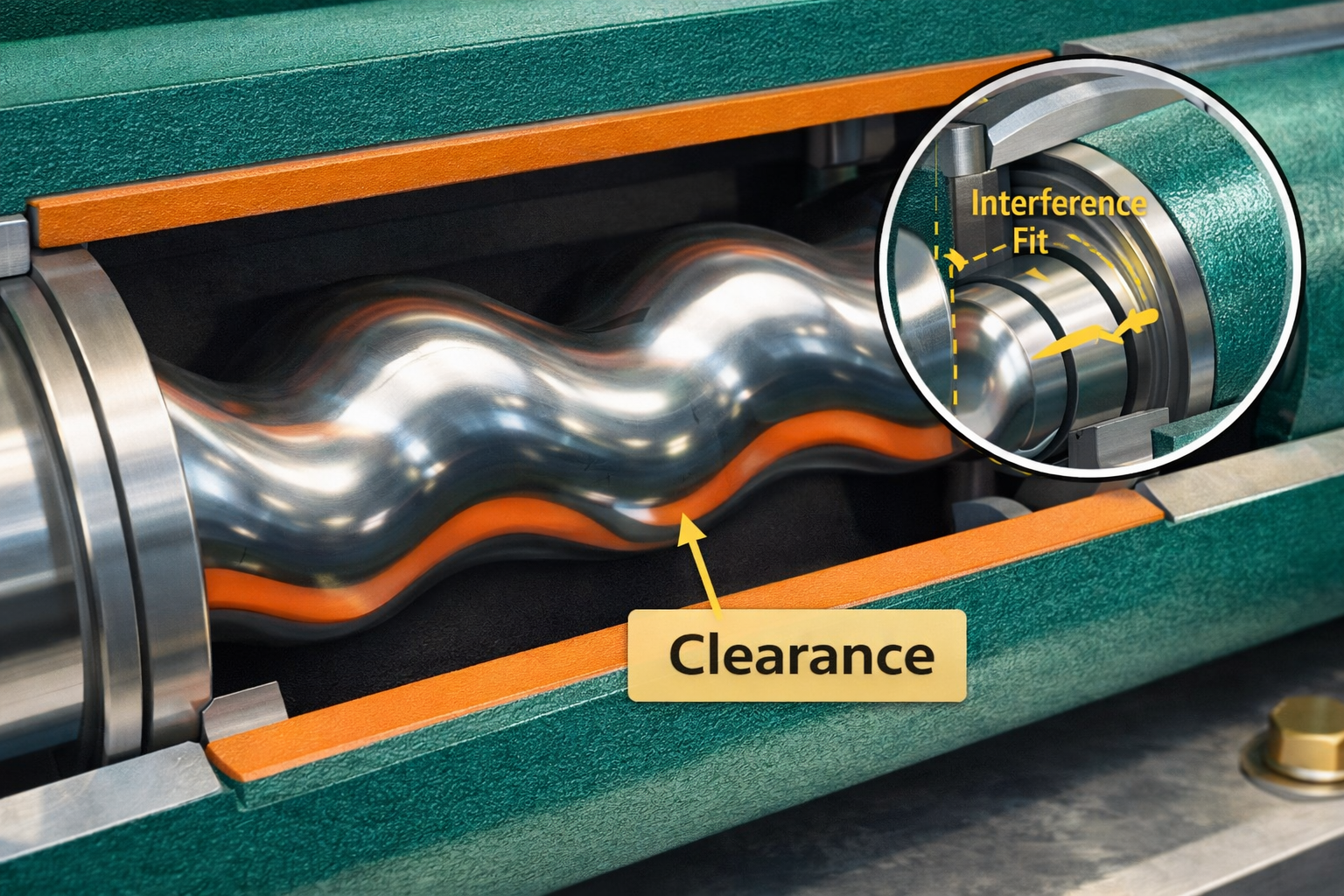
Table of Contents
- Why Do NETZSCH Pumps Clog? The Root Causes
- The Heart of the Matter: Rotor-Stator Clearance Explained
- Choosing Your Champion: A Guide to Stator Elastomers
- The Replacement Process: A Step-by-Step Guide
- Preventive Maintenance: Your Blueprint for Clog-Free Operation
- Conclusion & Your Next Step
1. Why Do NETZSCH Pumps Clog? The Root Causes
You hear that tell-tale change in pitch, the vibration starts, and the flow meter dips. Another clog. Before you consider drastic measures, let’s diagnose the common villains behind NETZSCH NEMO® pump blockages.
Think of your progressive cavity pump as a highly tuned digestive system. Just as our stomachs struggle with the wrong foods, your NETZSCH pump clogs when it’s fed media it can’t properly “digest” or when its internal mechanics (the rotor and stator) are out of sync. Understanding this is the first step to a cure.
The primary physical cause of clogging is the loss of the precise, sealed cavities that move fluid from suction to discharge. When the rotor and stator wear out or are mismatched, these cavities leak, causing slippage, inefficient pumping, and ultimately, a buildup that leads to a full blockage. It’s a slow decline in performance that ends in sudden failure.
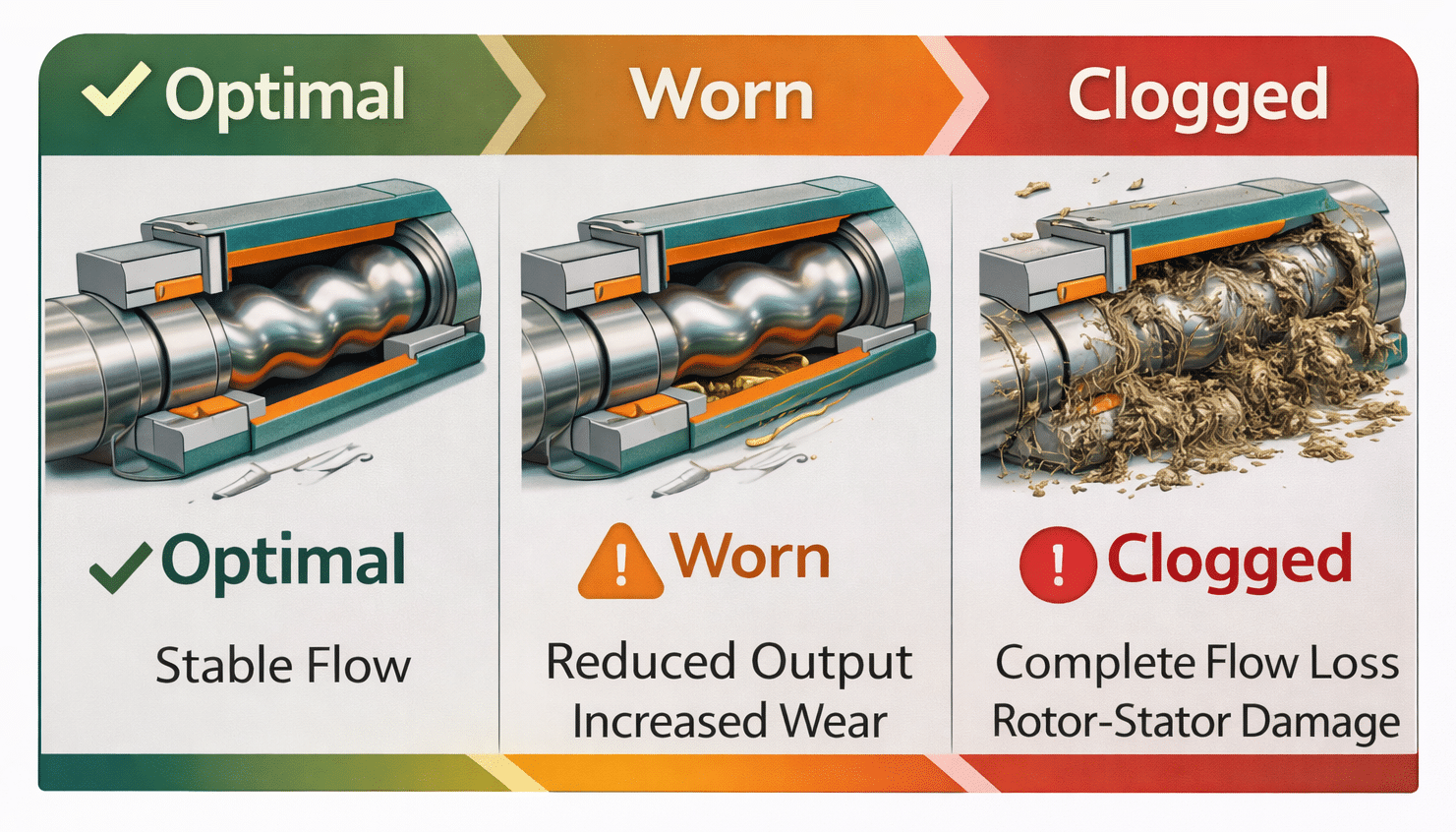
Let’s break down how minor wear initiates a major clogging event.
The Wear Sequence:
- Initial Erosion: Abrasive particles in the media slowly erode the stator elastomer and the rotor metal surface.
- Clearance Increase: This erosion widens the critical rotor-stator clearance, breaking the tight seal.
- Performance Drop: Fluid slips back through the increased gap, reducing flow and pressure (flow rate and discharge pressure).
- Solid Settling: The reduced velocity allows solids to settle and compact within the pump housing or the stator tube itself.
- Complete Blockage: The compacted mass grows until it completely obstructs the cavity, causing the pump to stall.
| Symptom | Underlying Cause | Link to Future Clogging |
|---|---|---|
| Gradual loss of flow rate | Increased internal slippage due to wear | Allows solids to settle and accumulate |
| Higher energy consumption | Pump working harder to overcome slippage | Indicates advanced wear state |
| Increased product bypass | Loss of sealing in cavities | Leads to poor transfer and buildup |
2. The Heart of the Matter: Rotor-Stator Clearance Explained
This isn’t just a “gap”—it’s the pump’s engine. The rotor-stator clearance, often called the fit or interference fit, is the controlled space between the metal rotor and the elastomer stator liner. It’s what creates the sealed, progressing cavities that give the progressive cavity pump its name.
Imagine trying to squeeze a thick milkshake through a straw using a piston that doesn’t quite touch the sides. The shake just slips back. That’s exactly what happens in your NEMO® pump with incorrect clearance: the media slips back instead of being pushed forward, leading to inefficiency and clogging.
This clearance is meticulously engineered by NETZSCH for specific performance curves. When you replace a worn part, using a generic “one-size-fits-all” spare can be disastrous. An overly tight fit causes excessive heat and rapid wear, while a too-loose fit leads to immediate slippage, low pressure, and yes—clogging. Precision matters.
Choosing the right clearance is about matching the spare part to your exact application!
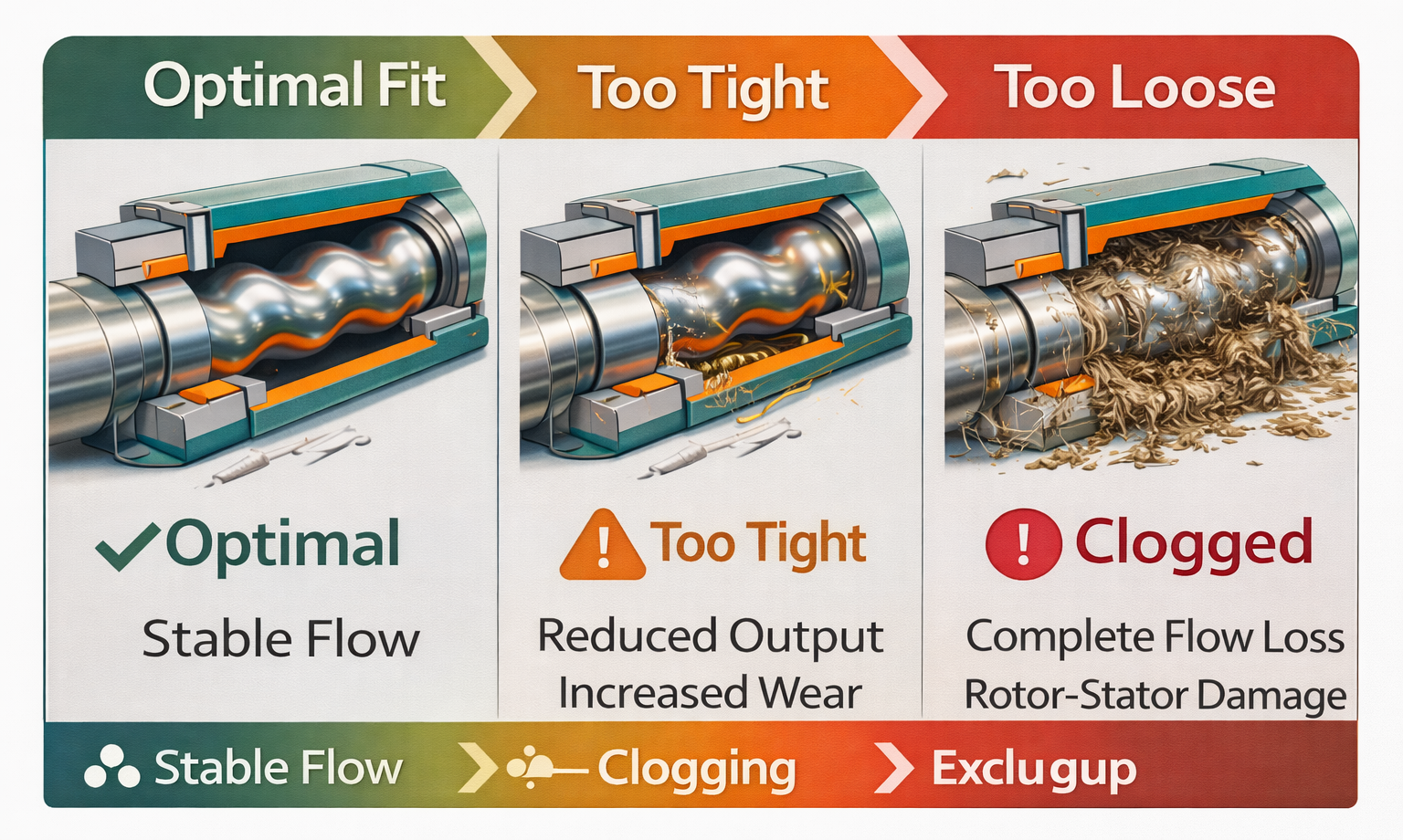
Understanding Clearance Codes & Wear Limits:
Pumps are built for different duties. A standard clearance is for general purposes. A tight clearance is for high-pressure applications or low-viscosity fluids to minimize slip. A loose clearance might be used for highly viscous or abrasive slurries to reduce shear and wear.
Key Question to Ask: Has my application changed since the original pump was specified? A change in media abrasiveness or solid content might necessitate a different clearance in your replacement parts to prevent future issues.
The Golden Rule: Always refer to your pump’s model and serial number to identify the original specification. High-quality replacement manufacturers like us can then replicate or even optimize this clearance based on your updated operational data. For more details on geometries, see our guide to NEMO® rotor-stator geometries.
3. Choosing Your Champion: A Guide to Stator Elastomers
The stator is the pump’s heart, and the elastomer is its muscle. It needs to be tough, flexible, and chemically resistant. Choosing the wrong material is like wearing rubber boots into a sulfuric acid bath—they’ll dissolve.
Your pumped media isn’t passive; it’s constantly interacting with the stator. Chemicals can attack it, heat can bake it, and abrasives can sand it away. Selecting the right stator elastomer isn’t a luxury—it’s essential defense planning for your pump’s longevity.
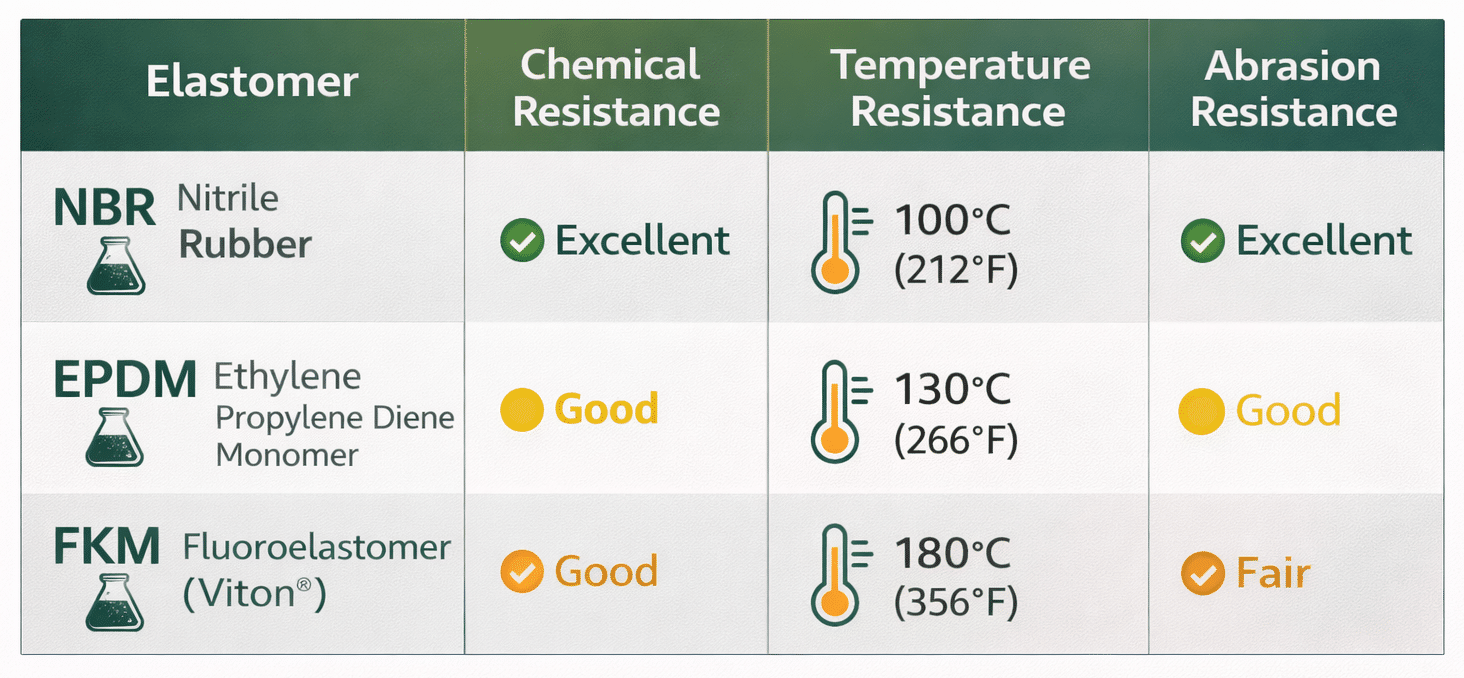
The most common pump stator materials are NBR (Nitrile) for oils and fats, EPDM for hot water and chemicals, and Fluorocarbon (FKM/FPM/Viton®) for aggressive chemicals and high temperatures. A swelling or degraded elastomer loses its shape, closing the critical clearance and creating a perfect scenario for a jam.
Compatibility is more than a simple “yes/no” from a chart.
Consider the Compound, Not Just the Base Polymer: Two stators labeled “EPDM” can perform wildly differently. The compound—the mix of base polymer, fillers, plasticizers, and curing agents—determines real-world performance.
| Application | Primary Threat | Elastomer Priority | Considerations for NETZSCH Spares |
|---|---|---|---|
| Wastewater/Sludge | Abrasion & Solids | Abrasion Resistance | Look for compounds with reinforced fillers. |
| Chemical Processing | Chemical Attack | Chemical Compatibility | Verify resistance with actual fluid mixture. |
| Food & Beverage | Cleanability & Compliance | FDA/Sanitary Approval | Ensure non-toxic, smooth-surface compounds. |
| High-Temp Fluids | Heat Aging | Temperature Range | Check continuous & peak temp ratings. |
4. The Replacement Process: A Step-by-Step Guide
Getting the right parts is 70% of the battle. Proper installation seals the remaining 30%. Even the best replacement stator and rotor will underperform if installed incorrectly.
You’ve invested in the perfect, precisely machined spare parts. Now, don’t let a rushed installation undo all that goodness. Taking the right steps ensures the new rotor-stator pair achieves its designed clearance and service life.
Always start with a complete lockout/tagout for safety. The core of the process involves carefully removing the old, worn stator—often the hardest part—and meticulously cleaning the pump housing before inserting the new one. Using the right lubricant during installation is not a suggestion; it’s mandatory to prevent damage.
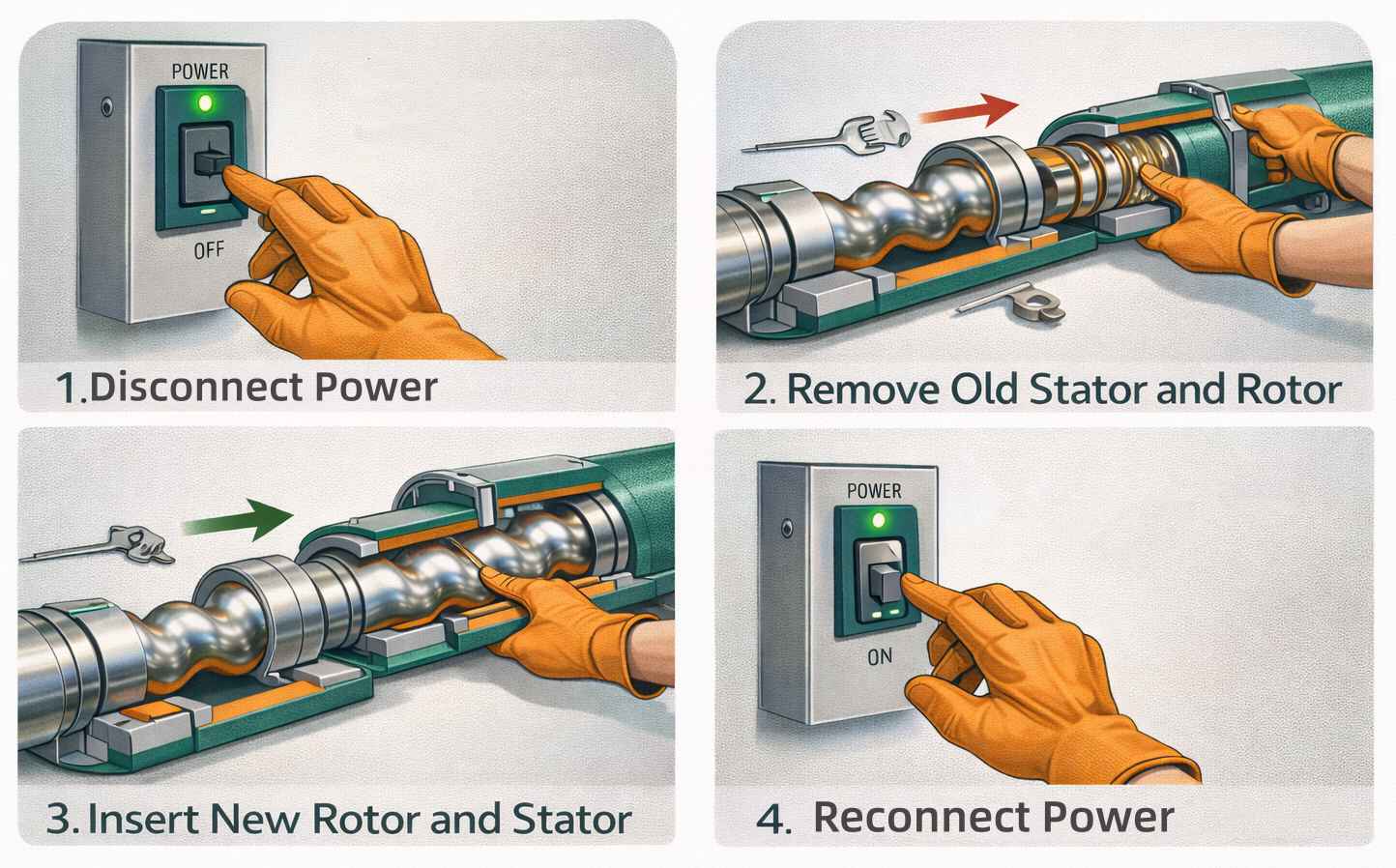
This step is frequently overlooked with catastrophic results.
Why Lubricate? A dry elastomer stator has immense friction against the metal housing. Forcing it in dry can tear, twist, or permanently deform it, ruining the precision clearance before the pump even starts.
What to Use?
- Soapy Water: A classic, simple, and effective option for most installations.
- Silicone Spray: Provides good lubrication and is inert.
MEDIA IS NOT A LUBRICANT! Never use the fluid you’ll be pumping (like oil or syrup). It can cause the elastomer to swell prematurely, making it impossible to insert fully or creating a too-tight fit.
Pro-Tip: After installation, if possible, perform a brief test run with water or a benign fluid to seat the parts and check for leaks before introducing the process media.
5. Preventive Maintenance: Your Blueprint for Clog-Free Operation
The goal isn’t just to fix clogs, but to prevent them. A smart preventive maintenance schedule for your eccentric screw pumps is cheaper than unplanned downtime.
Treat your NETZSCH pump like a championship athlete. Regular check-ups, the right “diet” (media), and listening to its signals (noise, vibration) prevent career-ending injuries—or in this case, catastrophic clogs and failures.
Schedule regular inspections of wear parts. Monitor performance data like flow rate and power draw—a gradual change is a warning sign. Also, ensure proper inlet conditions to avoid starving the pump, which leads to dry running and instant damage.
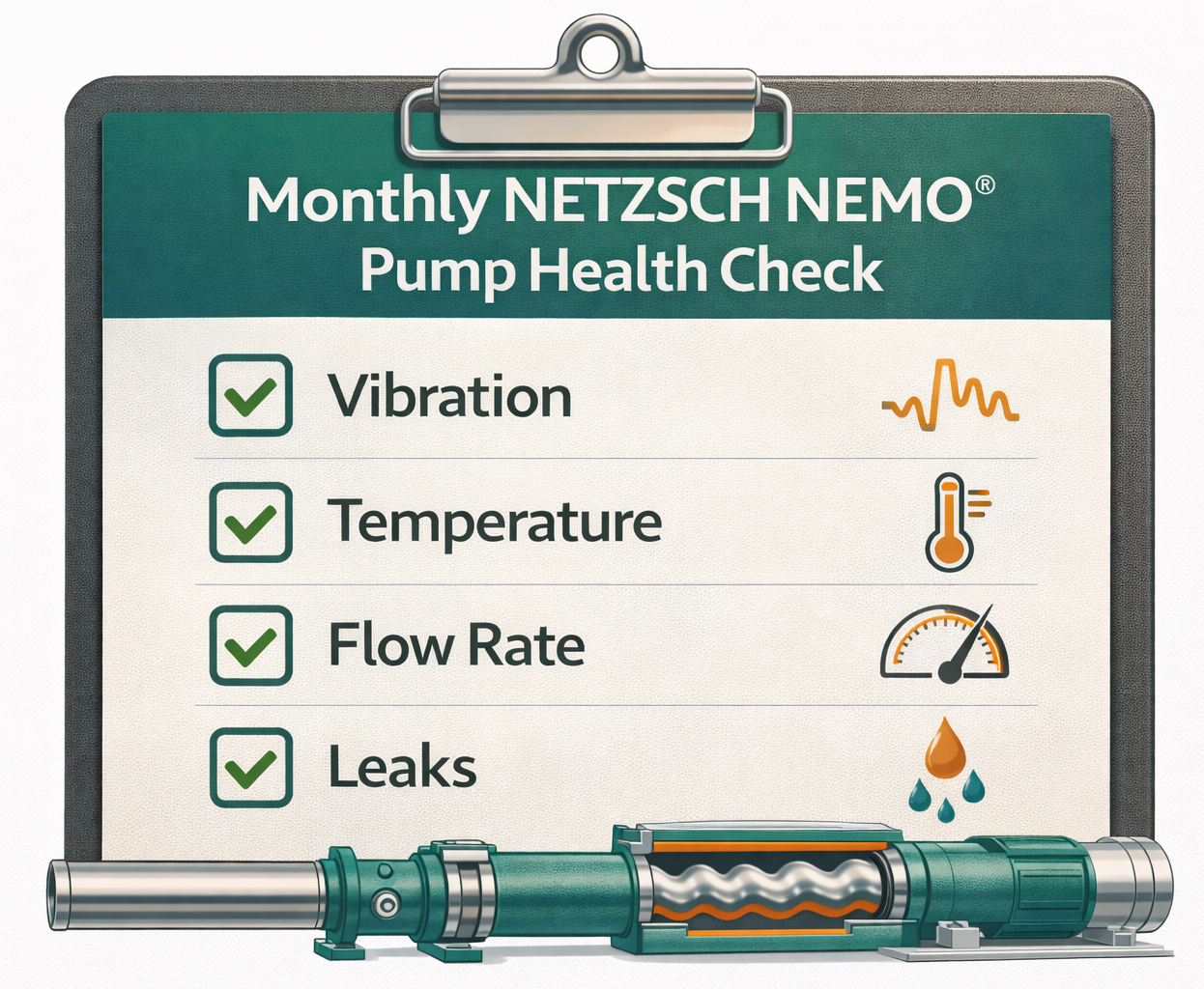
Weekly/Monthly Checks:
- Visual & Auditory: Unusual noise or vibration? Check foundation and coupling alignment.
- Temperature: Feel the pump housing and bearing frames. Excessive heat indicates friction or blockage.
- Leakage: Check shaft seals (mechanical seals or gland packings) and flange connections.
Quarterly/Annual Tasks:
- Performance Benchmarking: Record and compare flow output and amperage draw against the pump curve.
- Internal Inspection: During planned shutdowns, inspect the rotor for wear and the stator for swelling or cracking.
- Spare Parts Inventory: Keep critical replacement spare parts—like a stator, rotor, and universal joint kit—on hand. This turns a potential week-long shutdown into a 4-hour swap.
Conclusion & Your Next Step
Taming NETZSCH NEMO® pump clogging boils down to a powerful combination of knowledge and precision. By understanding the critical role of rotor-stator clearance and selecting the chemically compatible stator elastomer, you move from reactive troubleshooting to proactive performance management. Remember, the right replacement part isn’t just a copy; it’s an opportunity to optimize your pump for your specific, current application demands.
Stop battling constant blockages and the costly downtime they bring. As specialists in high-precision, compatible replacement parts for NETZSCH, Moyno, MONO, SEEPEX, ALLWEILER, and PCM pumps, we don’t just sell components—we provide solutions.
Ready to solve your clogging issues for good? Send us your NETZSCH pump model number and details about your pumped media. Our engineers will provide a free, no-obligation analysis and recommend the optimal rotor-stator pair—with the perfect clearance and material compound—to restore your pump’s reliability and efficiency. Contact our technical team today and let’s get your flow moving smoothly again.


